
SleepTwo Team
June 12, 2026 · 5 min read
Key insight
Research shows when you resolve arguments matters as much as how. Here's what science reveals about conflict timing and protecting both partners' sleep.
Are You Sleep Compatible?
Find out in 2 minutes — free
The Argument at 11 pm That Nobody Wins
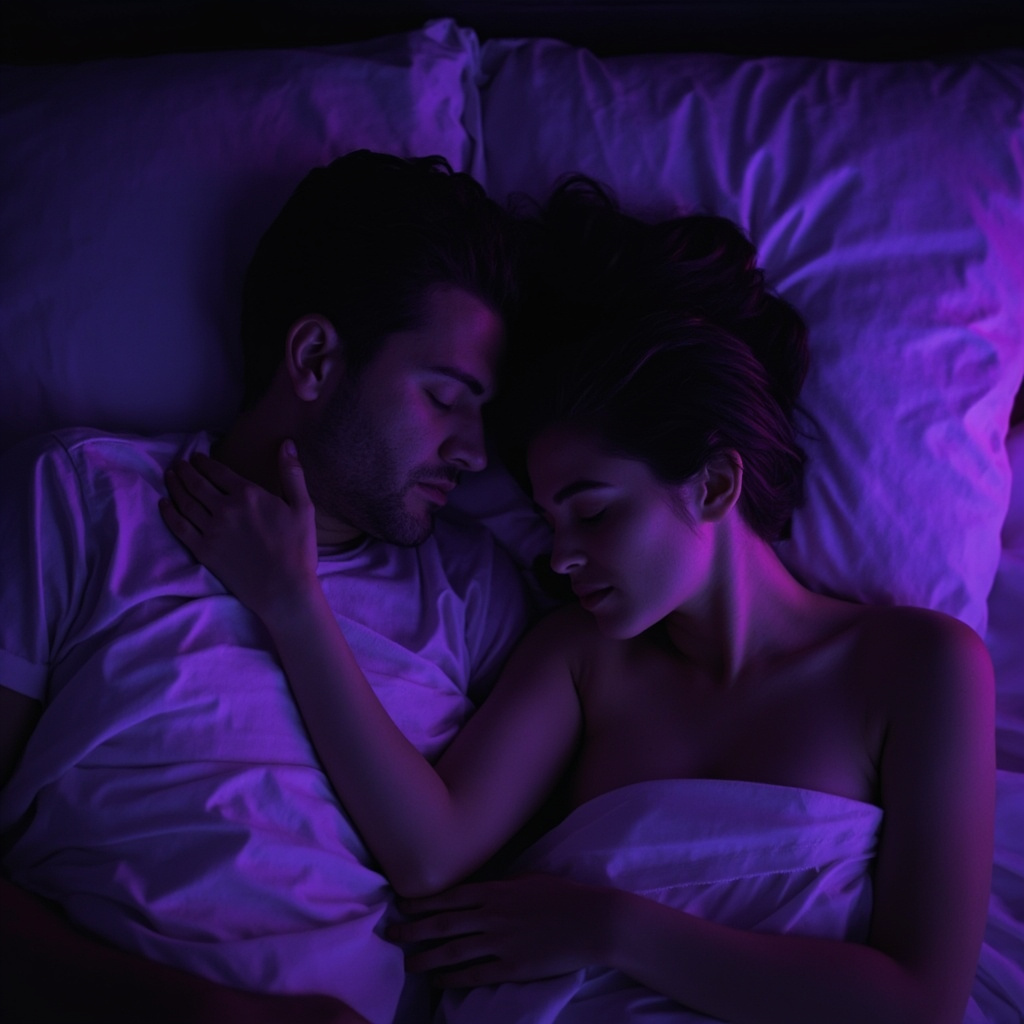
Most couples know the scenario. A difficult day spills into the evening. Someone says something sharp over dinner. By 10 pm, the tension has not resolved, and now both partners are lying in bed in the dark, neither quite ready to sleep, the disagreement hanging unfinished in the air between them.
The outcome — fragmented sleep, elevated heart rates through the night, groggy and irritable mornings — is predictable. But researchers have found something more specific and more actionable: it is not only the fact of a conflict that disrupts sleep. It is when in the evening a conflict occurs, and whether the nervous system has enough time to downregulate before sleep onset, that determines the physiological cost each partner pays that night.
Conflict timing is a lever that couples rarely think about. It is worth thinking about.
What Cortisol Needs to Wind Down
To understand why timing matters, it helps to understand the cortisol arc of an evening. Cortisol — the body's primary stress hormone — follows a daily curve that reaches its lowest point in the hours after midnight, enabling the deep slow-wave sleep that the body uses for physical restoration. In a healthy pattern, cortisol has been declining since early afternoon, dropping steadily through the evening toward its nadir.
An argument activates the hypothalamic-pituitary-adrenal (HPA) axis, triggering a cortisol release that interrupts this natural descent. How significantly it interrupts depends on the intensity of the conflict and — critically — how much time remains between the confrontation and sleep onset for the cortisol to clear and the HPA axis to return to baseline.
Research in psychoneuroendocrinology has documented that cortisol has a half-life of approximately 60 to 90 minutes after a stressor, meaning a significant conflict at 10 pm may still be producing elevated cortisol well past midnight. The cortisol that was supposed to have reached its lowest point — enabling deep, restorative sleep — is instead circulating at a level associated with wakeful alertness and threat response.
The practical implication is stark: a conflict resolved at 8 pm, allowing 90 minutes of cortisol clearance before typical sleep onset, produces a fundamentally different night from the same conflict unresolved at 11 pm.
The REM Sleep Problem
Beyond cortisol, unresolved emotional conflict has a specific and damaging effect on REM sleep. REM is the stage in which the brain processes emotional experiences, consolidates memories, and — critically — strips some of the emotional charge from difficult events so they can be recalled without the same intensity of distress.
A 2011 study from the University of Massachusetts found that negative emotional experiences encoded before sleep were more vividly retained the following morning than those allowed to resolve or process before bed. The mechanism: REM sleep consolidates whatever emotional state accompanied the experience at sleep onset. Going to bed with unresolved anger or hurt effectively instructs the brain to cement that emotional state more permanently.
For couples, this means the argument you brought to bed is, in a physiological sense, more entrenched by morning — not because either person chose to hold onto it, but because the brain did its nightly consolidation work on the emotional state it found at sleep onset.
The Window That Makes the Difference
Sleep researchers and couples therapists have converged on a similar framework: the two hours before typical sleep onset are not a good time to open emotionally significant conflicts. Not because those feelings are unimportant, but because neither partner's nervous system is in a state that supports productive resolution, and because the sleep cost of a late-evening conflict is higher than most couples recognise.
This is not an argument for suppression. Unprocessed conflict that is pushed aside without acknowledgment creates its own physiological cost — sustained low-grade activation that shows up in elevated overnight heart rate and reduced HRV. The distinction is between deliberately postponing a conflict to a time when both partners are better resourced, versus silently stewing without agreement to return.
Research on couples' conflict processes by John Gottman and colleagues at the University of Washington found that the capacity for effective repair after conflict is highly sensitive to baseline arousal level. Partners who are physiologically dysregulated — elevated heart rate, elevated cortisol — cannot access the prefrontal regulation needed for genuine empathy, perspective-taking, or de-escalation. The best conversations about hard things happen when both nervous systems are calm, not when they are on the edge of sleep.
Four Practical Approaches for Tonight
Set a conflict curfew. Agree together that contentious or emotionally loaded conversations will not begin after a set time — typically 90 minutes before your usual sleep onset. This does not mean suppressing feelings; it means both partners explicitly agreeing that this topic will be returned to tomorrow, and that acknowledgment itself allows the nervous system to release some of the activation. "We will talk about this tomorrow after dinner" is neurologically different from "we're not talking about this."
Create an earlier window for hard conversations. The best time for couples to process conflict is in the early to mid-evening — after the peak work stress of the day has passed but well before the fatigue and cortisol sensitivity of late evening. Research on emotional regulation consistently shows that both cognitive flexibility and empathy are higher when people are not fatigued. A difficult conversation at 7 pm, when dinner is done and the night is still ahead, produces better outcomes than the same conversation at 10:30 pm.
End with a small act of acknowledged connection. Research by Julianne Holt-Lunstad at Brigham Young University found that couples who maintained physical closeness during conflict periods had significantly lower cortisol than those who became physically distant. A brief, genuine moment of warmth before sleep — not a forced resolution, but a simple acknowledgment that you are still on the same side — measurably lowers the cortisol that disrupts deep sleep. The gesture does not require the argument to be over; it requires only that safety is signalled.
Watch your data to see the pattern. Many couples notice morning irritability or poor sleep on nights following conflict, but rarely connect the timing of the argument to the quality of the night. Tracking both partners' sleep data — HRV, overnight heart rate, time to fall asleep — reveals this pattern with clarity that subjective memory cannot. Seeing that the nights with the worst compatibility scores consistently follow late-evening conflict is motivating in a way that abstract advice is not.
Start Tracking Tonight
SleepTwo tracks both partners' sleep every night via Apple Watch, including HRV, overnight heart rate, and sleep stages — the metrics most sensitive to conflict-driven cortisol elevation. When you can both see that a late-evening argument produces measurably worse individual scores and a lower nightly compatibility score, conflict timing stops being a vague recommendation and becomes something you can see in your own data. Download free on the App Store — Together Pro covers both partners. sleeptwo.app
Research & further reading
- Sleep and Relationship Functioning— PubMed Central
- Sleep and Emotions— American Psychological Association
Stop guessing. Start knowing.
SleepTwo gives couples a real 0–100 compatibility score every morning — based on actual sleep data, not a quiz. Free to download. One subscription covers both of you.
iOS 17+ · iPhone mic or Apple Watch · Free download