
SleepTwo Team
June 21, 2026 · 5 min read
Key insight
Bedtime gratitude is one of the few habits that improves both partners' sleep quality and relationship health simultaneously. Here's what research shows.
Are You Sleep Compatible?
Find out in 2 minutes — free
The Practice That Fixes Both Your Sleep and Your Relationship at Once
Here is a finding that most couples walk past every day: people who regularly express specific gratitude before bed fall asleep faster, sleep longer, and wake with better mood than those who do not. The research on gratitude and sleep is unusually consistent — and the couple-specific mechanisms make it even more compelling than the individual findings suggest.
Gratitude before bed is not a soft wellness practice. It is a neurochemical intervention that directly addresses some of the most common physiological barriers to sleep, and it acts on both partners simultaneously.
What Gratitude Does to the Pre-Sleep Brain
The neuroscience of gratitude is more specific than popular accounts tend to suggest. When you genuinely recall something you appreciate — particularly something involving another person — it activates the prefrontal cortex and the brain's reward circuitry while simultaneously reducing activity in the amygdala, the brain's threat-detection and fear-response system.
This matters enormously for sleep. Amygdala hyperactivation is one of the most consistent physiological signatures of sleep difficulty: in people who struggle to fall asleep, the amygdala remains too active too late into the evening, keeping the nervous system in a state of vigilance when it needs to be settling toward rest.
Research by Alex Wood and colleagues, published in the *Journal of Experimental Social Psychology*, found that gratitude significantly predicted sleep quality, with the relationship mediated by a reduction in pre-sleep cognitive arousal — specifically, a reduction in the worrying and ruminative thoughts that delay sleep onset and fragment early sleep. People with higher gratitude were thinking about fewer negative, intrusive thoughts before bed. Their mental environment at sleep onset was quieter.
The Cortisol Connection
Gratitude's sleep benefit runs through a second, more direct physiological pathway: cortisol regulation. Cortisol — the body's primary stress hormone — follows a daily arc that should reach its lowest point in the late evening, enabling the deep slow-wave sleep that the body uses for physical restoration. Anything that keeps cortisol elevated into the evening delays this descent and fragments the sleep that follows.
Research by Robert Emmons at UC Davis, one of the most prominent gratitude researchers, found that people who engaged in regular gratitude practices showed lower diurnal cortisol than control groups. For sleep, the relevant finding is the evening specifically: gratitude practitioners showed a steeper cortisol decline in the hours before bed, meaning their bodies reached the low-arousal state that enables deep sleep more readily.
For couples, this cortisol pathway matters in two directions. Expressing genuine appreciation activates the parasympathetic nervous system in the person speaking. Receiving genuine appreciation — being seen and valued — suppresses the stress axis in the person receiving. A brief mutual gratitude exchange before sleep is shifting both partners' cortisol curves simultaneously, each amplifying the other's effect.
Oxytocin: The Third Mechanism
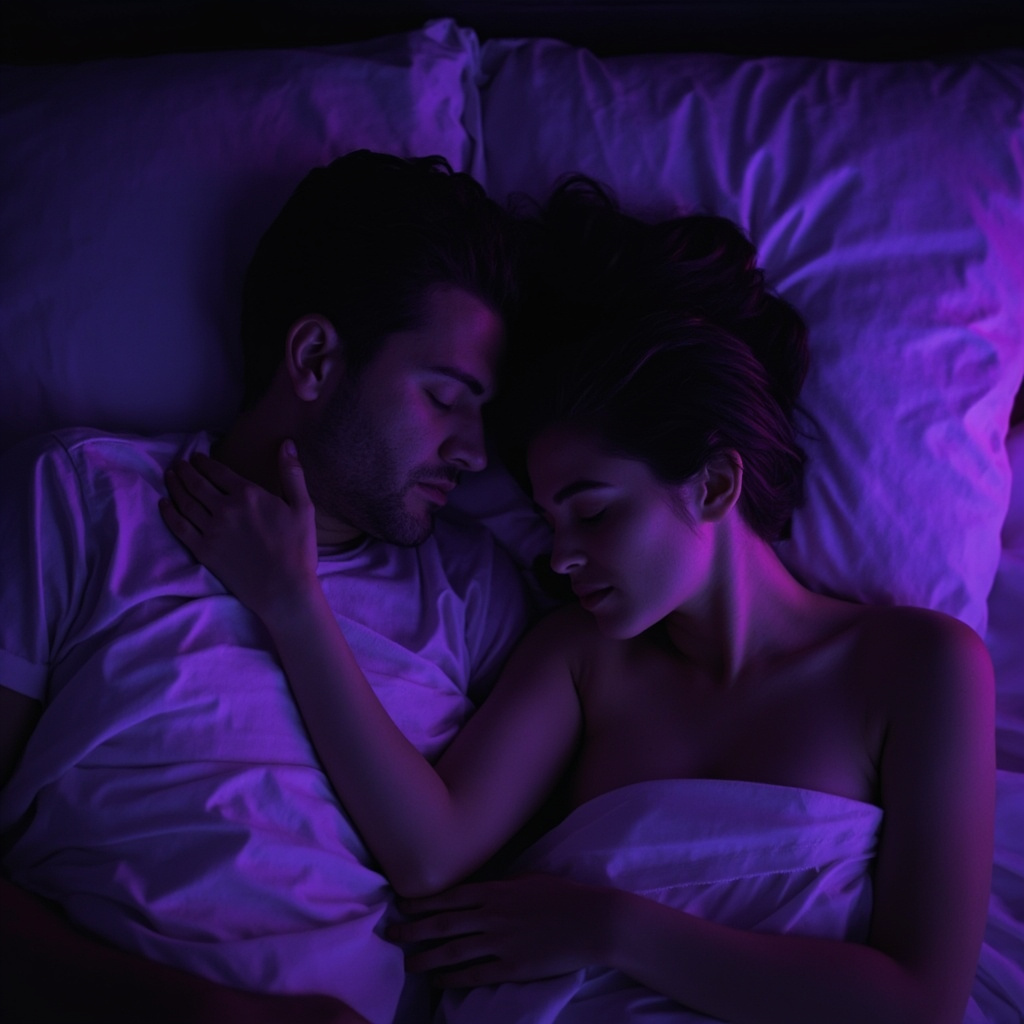
When gratitude is expressed between romantic partners with physical contact — a hand held, lying close, making eye contact — it triggers oxytocin release in both people. Oxytocin directly suppresses the HPA axis, further reducing cortisol, and promotes the felt sense of safety that co-regulation between partners depends on.
Research by Julianne Holt-Lunstad has linked higher oxytocin in couples to better overnight cardiovascular recovery and lower nighttime sympathetic nervous system activity — both of which translate into deeper sleep. The combination of verbal gratitude and physical proximity before sleep therefore acts on three systems simultaneously: cognitive reappraisal (reducing rumination), cortisol regulation (enabling sleep onset), and oxytocin release (activating parasympathetic co-regulation).
The result is both partners entering sleep in a neurochemically calmer, more connected state — one that research on co-sleeping couples consistently associates with better deep sleep, stronger HRV, and greater physiological alignment across the night.
The Relationship Amplifier
Research by Amie Gordon and colleagues at UC Berkeley found that people who expressed more gratitude toward their partners on a given day showed better relationship functioning the following day — more positive perceptions, greater willingness to resolve conflict, and more felt closeness. The gratitude was not merely reflecting a good relationship; it was actively improving it.
For sleep, this relational amplifier matters because the emotional climate of the relationship at bedtime is one of the strongest determinants of sleep architecture. Couples who go to bed feeling appreciated and seen go to bed in a fundamentally different physiological state than those who go to bed feeling neutral or unacknowledged. Unresolved tension, felt distance, or the chronic low-grade disconnection of not being noticed — all produce elevated evening cortisol and reduced autonomic co-regulation. Gratitude works in the opposite direction, each night.
Four Practical Approaches for Tonight
Name one specific thing, not a general sentiment. "I noticed you made space for me this afternoon when you had a full day" activates stronger emotional processing than "thanks for everything you do." Specificity signals genuine attention — that you were actually watching your partner — and this activation of the prefrontal reward system is stronger when the observation is particular.
Keep it brief. One specific exchange each, two minutes total, is sufficient. The goal is a genuine neurochemical close to the day, not an extended appreciation session. Authenticity matters far more than duration.
Combine with physical contact. Expressing gratitude while in physical contact — a hand on the back, lying close, arms around each other — simultaneously engages the oxytocin system. Touch channels the gratitude into a physiological outcome that verbal expression alone does not fully achieve.
Practise it before a device goes on. The gratitude exchange should happen before phones are checked one final time, not after. Once a screen opens, the engagement and blue light exposure that follow compete with the neurochemical settling the gratitude has begun.
Start Tracking Tonight
SleepTwo tracks both partners' sleep via Apple Watch every night, making it possible to see whether adding a bedtime gratitude practice produces measurable changes in sleep onset, deep sleep, HRV, and your nightly compatibility score. Couples who build this practice often notice the first improvements within a week — earlier sleep onset, longer deep sleep, and a compatibility score that reflects the increased physiological alignment that comes from both partners entering sleep in a calmer, more connected state. Download free on the App Store — Together Pro covers both partners. sleeptwo.app
Research & further reading
- Sleep and Relationship Functioning— PubMed Central
- Sleep and Emotions— American Psychological Association

Stop guessing. Start knowing.
SleepTwo gives couples a real 0–100 compatibility score every morning — based on actual sleep data, not a quiz. Free to download. One subscription covers both of you.
iOS 17+ · iPhone mic or Apple Watch · Free download