
SleepTwo Team
July 4, 2026 · 5 min read
Key insight
A late-night fight doesn't end when you stop talking. Here's what an argument actually does to your body's ability to fall and stay asleep afterward.
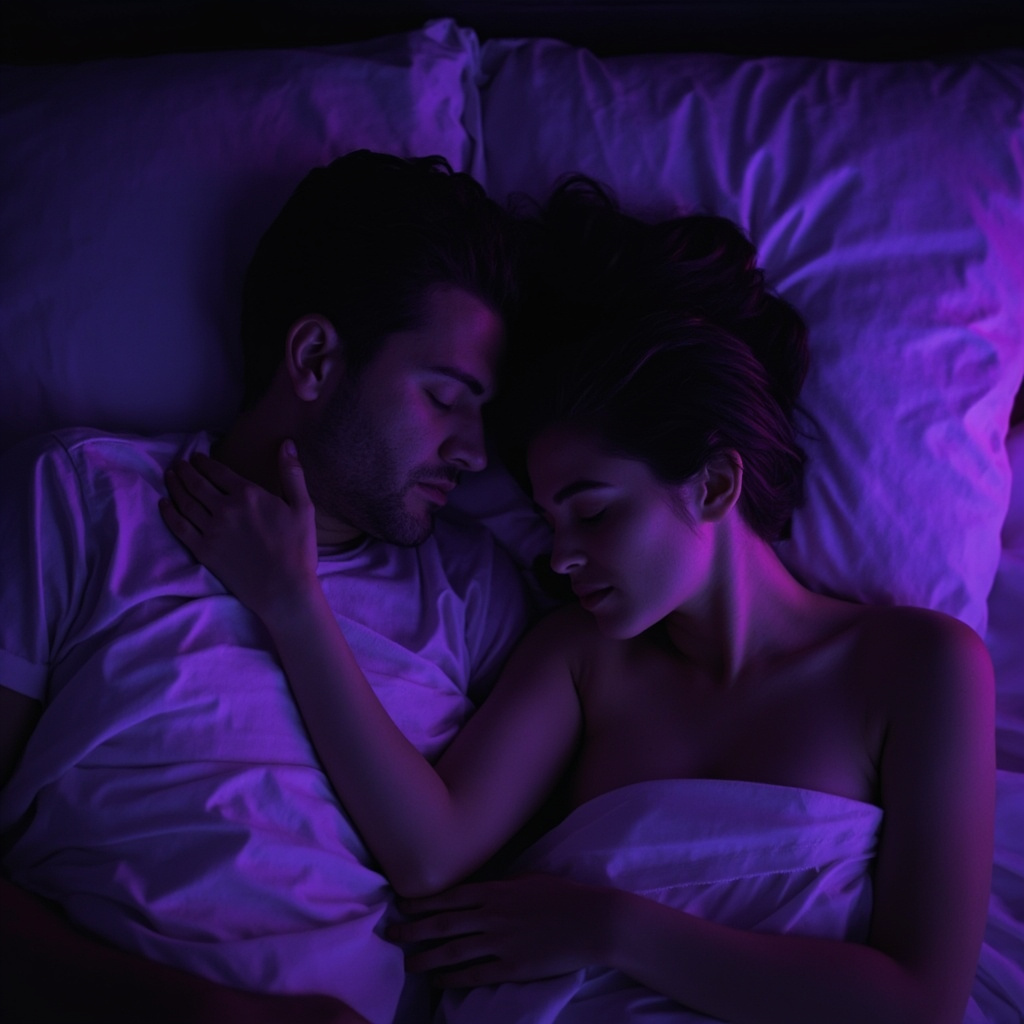
Are You Sleep Compatible?
Find out in 2 minutes — free
The Fight Doesn't End When You Stop Talking
You said goodnight. The lights are off. But your heart is still doing 95 beats a minute, your jaw is tight, and you're replaying the last thing they said instead of falling asleep. Your partner, six inches away, is doing the exact same thing.
This is one of the most common — and most misunderstood — patterns in couple sleep. The argument itself often lasts ten minutes. The physiological aftermath can last two or three hours, quietly wrecking a night's sleep for both people even after the topic has been dropped.
What an Argument Actually Does to Your Body
A conflict, even a quiet one, triggers the sympathetic nervous system — the same fight-or-flight response your body uses for any perceived threat. Heart rate rises, cortisol and adrenaline flood the bloodstream, and muscles tense. Sleep researchers call the psychological version of this "pre-sleep arousal": a state of cognitive and physiological activation that is directly incompatible with the parasympathetic, wound-down state sleep onset requires.
The Gottman Institute's research on marital conflict identified a related state it calls "flooding" — a point of physiological arousal, often above roughly 100 beats per minute, at which people can no longer process what their partner is saying or access their normal empathy and reasoning. Couples frequently try to "finish" an argument while flooded, which tends to make things worse rather than better, and it leaves both partners in an activated state exactly when their bodies need to be winding down for sleep.
Research from Ohio State University's Institute for Behavioral Medicine Research, led by Janice Kiecolt-Glaser, has tracked how marital conflict elevates stress hormones for hours afterward and even measurably slows physical healing overnight. Sleep isn't just delayed by an argument — the biological recovery sleep is supposed to provide gets blunted at the same time.
Why the Next Day Feels Worse, Not Better
There's a second layer to this that most couples never connect: sleep itself is part of how emotional experiences get processed. Research out of UC Berkeley's sleep lab, led by Matthew Walker, has shown that REM sleep plays a specific role in emotional memory consolidation — the brain appears to strip some of the raw emotional charge from an experience overnight while preserving the memory of what happened.
When an argument compresses or delays sleep, particularly the REM-heavy final cycles of the night, that overnight processing doesn't get to run its full course. The conflict can feel just as raw — or rawer — the next morning as it did the night before, because the biological mechanism that normally softens it never got the time it needed. This is part of why fights that happen late at night have a reputation for reopening the next day: the emotional file never actually got closed.
Four Things That Actually Help
Build a genuine buffer before bed, win or lose. A 30-45 minute stretch with no phones, no rehashing, and no new topics gives the sympathetic nervous system time to stand down regardless of whether the disagreement got fully resolved. This isn't about pretending everything's fine — it's about giving your body the physiological off-ramp it needs before you're lying still in the dark.
Stop trying to "win" while flooded. If either partner's heart is pounding and the conversation has turned into the same three sentences on repeat, that's the signal to pause — not push through. Agreeing in advance on a phrase like "I need twenty minutes" gives both people permission to physically self-soothe (slow breathing, a short walk, splashing cold water on the face) before returning to the conversation with an actual working brain.
Decide the topic doesn't have to close tonight. The old advice to never go to bed angry undersells how much worse a forced, flooded resolution attempt can be compared to a well-rested conversation the next day. Naming a specific time to revisit it — "let's talk about this properly tomorrow evening" — removes the pressure to resolve everything before sleep while making clear the issue isn't being dropped.
Notice the pattern, not just the fight. Couples who track how specific nights actually affected their sleep tend to get better at catching the pattern early — recognizing, for instance, that arguments after 9pm cost them measurably more disrupted sleep than the same disagreement held earlier in the evening. That awareness alone changes when people choose to have hard conversations.
Start Tracking Tonight
SleepTwo tracks both partners' sleep architecture every night via Apple Watch, which means the cost of a late-night argument stops being a vague feeling the next morning and becomes something visible — elevated heart rate, delayed sleep onset, a lower nightly compatibility score on exactly the nights conflict ran late. Seeing that pattern in your own data is often what finally convinces couples to move hard conversations earlier, or to build in the wind-down buffer that protects both partners' sleep. Download free on the App Store — Together Pro covers both partners. sleeptwo.app
Research & further reading
- Sleep and Relationship Functioning— PubMed Central
- How Sleep Affects Your Relationships— Sleep Foundation
- Sleep and Emotions— American Psychological Association
Stop guessing. Start knowing.
SleepTwo gives couples a real 0–100 compatibility score every morning — based on actual sleep data, not a quiz. Free to download. One subscription covers both of you.
iOS 17+ · iPhone mic or Apple Watch · Free download