
SleepTwo Team
June 20, 2026 · 5 min read
Key insight
Couples who sleep together often synchronize their breathing — research explains why this happens and what it reveals about sleep quality and relationship health.
Are You Sleep Compatible?
Find out in 2 minutes — free
The Fact You've Never Noticed
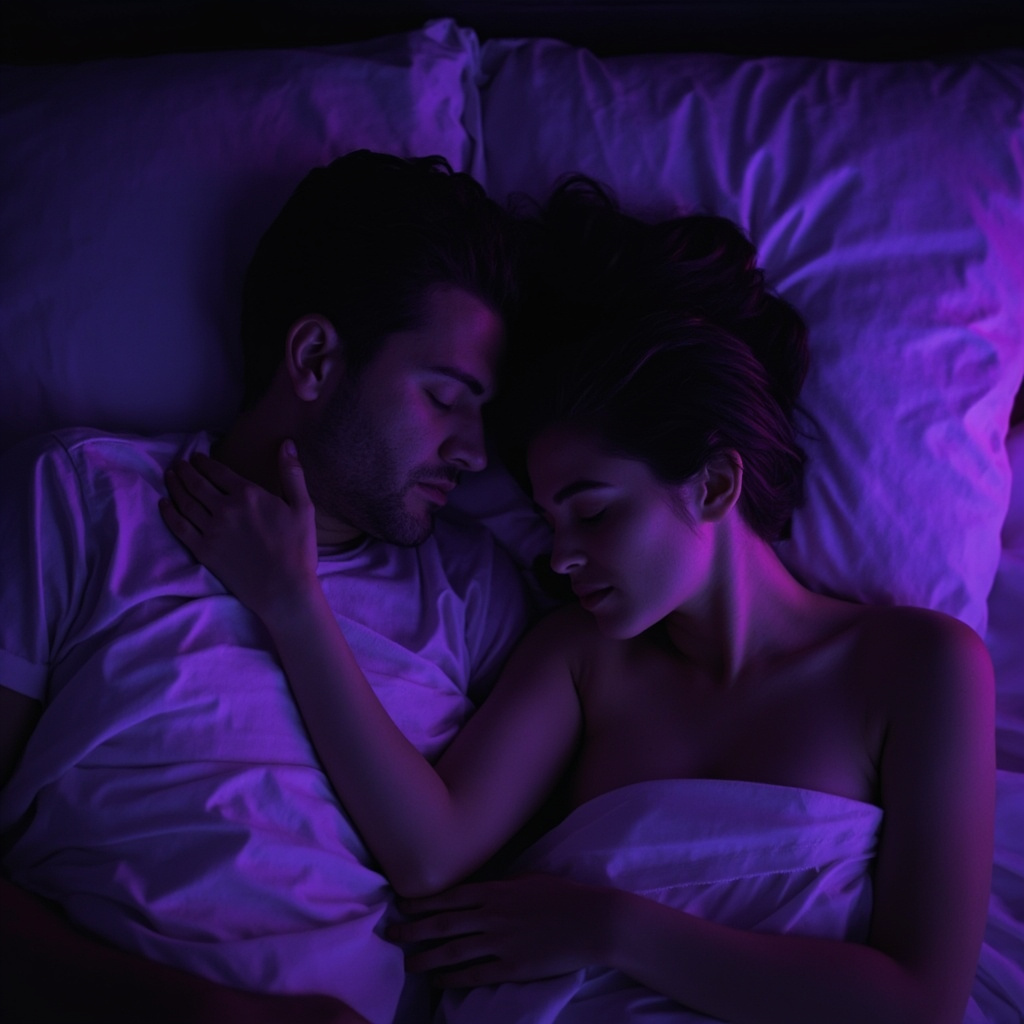
Every night, without awareness or effort, something remarkable can happen to couples who share a bed: their breathing gradually falls into the same rhythm. Inhale and exhale align until two people are cycling through the same respiratory pattern in near-unison. This is not coincidence, and it is not imagination. It is a measurable physiological phenomenon that researchers have now linked to relationship quality, autonomic health, and the quality of shared sleep itself.
Respiratory synchrony in co-sleeping couples has emerged as an unexpectedly rich research area over the past decade. The findings carry implications not just for sleep quality but for relationship health, stress biology, and what the autonomic nervous system reveals about intimate partnerships.
What the Research Has Found
A foundational study by Emilio Ferrer and colleagues at UC Davis examined breathing synchrony in couples during periods of close physical proximity and found that partners' respiratory rhythms became correlated in ways that exceeded chance. The degree of synchrony was stronger in couples who reported higher relationship satisfaction and emotional closeness. Later work extended this finding to the sleep setting, using respiratory monitoring in co-sleeping couples to track when and how breathing patterns aligned across the night.
The most striking finding is not that breathing sometimes synchronizes — this can happen in many shared spaces — but that the degree of synchrony reliably correlates with the quality of the partnership. Couples who report greater emotional closeness show stronger respiratory synchrony during sleep. Those in more distressed relationships show less. The breath, it turns out, is a surprisingly honest signal of the relationship's underlying state.
Research published in *Scientific Reports* examining physiological synchrony between couples found that this alignment extended to multiple biological signals — heart rate, respiratory rate, and skin conductance — and was consistently stronger in couples with high relationship quality. When breathing falls into sync during sleep, it is not happening in isolation; it is part of a broader physiological conversation that two nervous systems are having with each other throughout the night.
Why Breathing Synchronizes: The Autonomic Mechanism
To understand why two people's breathing would align during sleep, it helps to understand how the autonomic nervous system governs respiration. Breathing is unusual in being both voluntary and involuntary — you can control it consciously, but it continues on its own during sleep. Its rhythm is heavily shaped by the autonomic system's current state.
When the parasympathetic nervous system dominates — the "rest and digest" branch associated with safety, recovery, and deep sleep — breathing slows, deepens, and becomes more regular. When the sympathetic branch activates, breathing quickens and becomes shallower. In a close partnership, these autonomic states become coupled through co-regulation: the process by which two people in an intimate relationship modulate each other's physiological states even without conscious intent.
When both partners enter the parasympathetic state together — which happens most readily when both feel safe, connected, and at ease in the shared space — their breathing naturally converges toward a similar pace. The synchrony is not the cause of the co-regulation; it is evidence that co-regulation is working.
Research by Stephen Porges on polyvagal theory has documented how the ventral vagal nerve circuit — which activates in the presence of felt safety and social connection — directly governs respiratory rate. Partners whose ventral vagal systems are simultaneously activated by the relational safety they feel together will show correlated respiratory rhythms because both nervous systems are being driven by the same underlying signal.
What Disrupts Synchrony
If respiratory synchrony reflects the quality of autonomic co-regulation, then the conditions that disrupt co-regulation will disrupt synchrony. The most significant:
Unresolved conflict. Going to bed with unprocessed emotional tension activates the sympathetic system in both partners, accelerating and destabilising respiration in each person differently. Synchrony requires a shared parasympathetic state; unresolved conflict prevents one from forming.
Misaligned sleep stages. Breathing changes substantially across sleep stages — slower and more regular in deep slow-wave sleep, faster and more variable in REM. Partners who are in different sleep stages simultaneously will breathe at different rates as a natural consequence. Greater sleep stage alignment produces greater respiratory synchrony as a byproduct.
Physical separation in the bed. Research on physiological synchrony consistently finds that the effect is stronger when partners are physically closer. The ambient co-regulation signals — warmth, subtle touch, the felt presence of another body — attenuate with distance.
Four Practical Approaches for Tonight
Create a warm close before sleep. Respiratory synchrony is easiest to achieve when both nervous systems are already entering a similar parasympathetic state at sleep onset. A brief, genuine moment of closeness before sleep — a few warm words, sustained physical contact, or simply lying together in the dark without an agenda — primes both systems for the co-regulated state that synchrony follows from.
Try paced breathing together before you fall asleep. Shared slow breathing — a four-second inhale, six-second exhale — brings both partners' respiratory rhythms into temporary alignment and measurably increases HRV in both people. Doing this for two to three minutes before sleep is sufficient to shift both nervous systems toward the parasympathetic state that natural nighttime synchrony requires.
Maintain physical proximity rather than maximise space. Couples who sleep in close physical proximity show stronger autonomic synchrony than those who sleep far apart. If temperature is the main barrier to closeness, separate lightweight duvets allow each partner to regulate their own warmth while preserving physical proximity — a common Scandinavian solution that eliminates the thermal cost of closeness without the relational cost of distance.
Resolve or explicitly table conflict before bed. The bedroom is not a good setting for opening difficult conversations, not because the feelings are unimportant but because neither partner can achieve the parasympathetic state that synchrony requires while carrying unresolved emotional activation. An explicit agreement to revisit a conversation tomorrow — "let's continue this after breakfast when we're both rested" — allows both nervous systems to release the threat response and enter sleep in a co-regulated state.
Start Tracking Tonight
SleepTwo tracks both partners' sleep every night via Apple Watch, capturing sleep stages, HRV, overnight heart rate, and the physiological patterns that reflect your shared nervous system state. Your nightly compatibility score shows how closely your sleep rhythms aligned — the same co-regulation that respiratory synchrony reflects. When both partners' deep sleep aligns, their HRV tracks together, and their scores are high, you are seeing the signature of the same biological connection that synchronized breathing represents. Download free on the App Store — Together Pro covers both partners. sleeptwo.app
Research & further reading
- Sleep Deprivation and Deficiency— NIH / NHLBI
- Stages of Sleep— Sleep Foundation
- How Much Sleep Do We Really Need?— Sleep Foundation
Stop guessing. Start knowing.
SleepTwo gives couples a real 0–100 compatibility score every morning — based on actual sleep data, not a quiz. Free to download. One subscription covers both of you.
iOS 17+ · iPhone mic or Apple Watch · Free download